Thursday, March 13, 2014

Winter Update

As winter continues to linger there is a growing concern among many superintendents in the northeast as to what effect this winter will have on the turf. 


Snow cover is good for the golf course.  Snow acts as an insulating blanket that protects the grass from the extreme low temperatures and harsh winter winds.  Ice on the other hand is not good.  Ice covering the turf prevents CO2 gas from escaping into the atmosphere.  Prolonged exposure to high levels of CO2 can lead to turf loss.  As a rule of thumb bentgrasses can tolerate up to 120 days under ice cover while Poa annua can only survive about 45 days.  Because our greens at Huntsville are a mixture of bentgrass/ Poa annua and we are approaching 45 days under snow and ice coverage, my assistant Casey Sheehan and I went for a walk around the course to inspect the greens for possible injury.


Our first stop was the 8th green.  This green was covered with about 3 inches of snow and a 1/2” thick layer of ice.  We removed the ice and looked at the turf underneath.  Everything looked good.  Most importantly, when we uncovered the turf, we were not meet with “the smell of death”.  “The smell of death” is a term superintendents like to use to describe the odor that dead turf gives off under ice.


Next we proceeded down to the 4th and 5th greens.  These greens had about 5 inches of snow covering a 2 inch thick layer of ice.  The thick ice and melting snow made it a little harder to see the turf but from what we observed the grass still looks good.


We also took a small sample of the green and brought it back the maintenance building for observation.  If the grass greens up and starts to grow, we will know that the turf is still healthy.


There is much debate about the best way to deal with ice on a green.  Some superintendents choose to remove the ice.  However there are two problems with removing the ice.  First, the process of removing the ice itself can cause significant damage to the green.  Secondly, if you remove the ice and expose the turf to warm temperatures and then get a period of low temperatures you can lose turf through what is known as crown hydration.

Based on what we have observed so far, we have decided to leave the snow and ice in place and continue to monitor the health of the greens.  If it is determined that the ice is causing problems then at that point we will take the necessary steps to prevent further turf loss.

Some parts of the golf course have already lost its snow cover.  All of these exposed areas look good.  We have not seen any ice damage and there is no sign of snow mold.  Snow mold is a fungus that can attack the turf in the winter.  We treat for this disease preventativly in the fall and I am happy to say that those applications seem to have been effective.


With warmer temperatures in the forecast, we hope to loose a lot of the remaining snow cover and prevent any ice damage from occurring.


Friday, July 12, 2013

Hydraulic leak


One of a superintendent’s worst fears is a hydraulic leak, especial one that occurs on a green.  As luck would have it on Sunday July 7 this is exactly what happened at Huntsville.  


#13 Green immediately after leak

The leak was caused by a failing oil seal on one of our greens rollers.  The leaking oil resulted in small spots and thin lines of damaged turf.  Unfortunately the operator did not notice the leak until several greens had been damaged.  The greens affected were #3, #5, #7, #10, #12, #13 and #17.

Many people have asked why the operator did not stop sooner.  Hydraulic leaks however can be very difficult to detect initially, particularly when the leak is small like the one we experienced.  Hydraulic oil is a clear liquid and it has no odor. Noticing hydraulic oil on wet grass in the early morning light can be almost impossible.  It is not until sometime later that the damage becomes very apparent.


Fortunately for us the leak was light resulting in mostly superficial damage.  The damaged turf should recover in a week or two.

#13 Green five days after leak


We are now carefully inspecting all of our rollers and replacing oil seals and hydraulic motors as needed to prevent this from happening again.


Thursday, June 13, 2013

Sun screen for your turf?

Yes that right, there is a new product on the market called Turf Screen that is being marketed to protect your turf from harmful UV radiation. 


Turf Screen
  Turf Screen was the brain child of Scott May who was the golf course superintendent of Manufactures Golf and Country Club near Philadelphia, PA.  After applying the product to his golf course and seeing how beneficial it was, he quit his job as superintendent and started up a  company to sell Turf Screen to golf courses full time.  The active ingredients in Turf Screen is zinc oxide, the same white stuff that you see on the noses of life guards at the beach.  The theory goes that all plants are susceptible to sunburn and solar stress from UV radiation and that Turf Screen will protect your plants from that damage.  Superintendents who have used the product report decreased water use, decreased canopy temperature, decreased turf stress and wilt, and improved plant health.  With so many positive testimonials I had to try it.  We applied Turf Screen to the greens on Wednesday.  The product contains a green pigment which made the greens a nice green color.  We will continue to experiment with this product and keep you updated on the results we are seeing.


Green color response from Turf Screen applied to the left. Untreated turf to the right.

We have also been doing some bunker work.  Over time grass along the edge of the bunkers creeps into the sand.  Periodically we need to identify where the original edge of the bunker was and cut the grass back.  In some places the grass has grown in a foot or more.  The shape of the bunker edges are an integral part of a golf course architects design. By cutting the bunkers back to their original lines we are maintaining the integrity of the Rees Jones design.


Removing grass that had grown into the bunker sand.


The chipping green bunker is also getting some much needed attention.  This particular bunker is very prone to wind sweeping the sand out of the bunker and depositing it outside the bunker.  Over time a layer of sand over 12 inches deep had accumulated at the far end just outside the bunker.  To repair this we stripped the sod, removed the built up sand back down to the original soil level and then replaced the sod.  We have this same problem on several bunkers on the course and hope to preform this same procedure to those bunkers later this summer.

Removing wind blown sand from outside the chipping green bunker.


Thursday, June 6, 2013

Hand Watering

As we progress into summer making sound water management decisions becomes increasingly important.  Finding the right balance between golfer’s expectations of firm fast conditions and sustaining healthy turf becomes increasingly difficult.

 
Weather Station

Although the irrigation system at Huntsville Golf Club is over 20 years old, it is still a very good system.  We have over 1,200 individual irrigation heads that are all controlled by a centralized computer.  We also have an on-site weather station which records evapotranspiration and can help to calculate how much to water to apply.  Despite these tools and technology, determining how much to irrigate is as much of an art as it is a science.  Applying too much water will lead to soft playing conditions, increased disease pressure and shortened root systems.  Apply too little and the grass will suffer from drought stress which could lead to turf loss.


"Hand watering gives you the ability to deliver water where it is needed.."

Hand watering a green
Modern irrigation heads are designed to apply water uniformly to the turf, unfortunately, the turf does not always dry out uniformly.  This is most evident on greens which are grown on sand for drainage purposes and can dry out very quickly.  As the green dries down certain ridges and high points tend to dry out first.  Although the simplest solution would be to run the irrigation heads, this would lead over watering areas of the green that are not dry.  It is at these times that hand watering becomes a vital maintenance procedure.  Hand watering gives you the ability to deliver water where it is needed while avoiding over irrigating other areas. 


Although no one likes to see maintenance workers hand watering the greens during the day.  Please be patient and understand that the greens staff is out there trying to produce healthy greens that are firm and fast.

Monday, May 13, 2013

It's seedhead time...
Casey Sheehan
Assistant GC Superintendent

As we get into another golfing season, a common question that we often hear early in the season is “why are the greens so bumpy in the spring?” This bumpiness is due to the high population of poa annua or annual bluegrass in the putting greens.  Since the annual bluegrass is an annual plant it produces seeds in the spring, even at the low mowing heights of a putting green.  As a result, these seedheads produce a bumpy and untrue putting surface.

Poa annua seedheads

In an effort to minimize the number of seedheads that the poa annua population produces, two spray applications are made in early spring.  These applications are a combination of two plant growth regulators (PGR), which over the last few years have shown to be somewhat successful in controlling the emergence of seedheads.

Since every annual bluegrass plant will not produce seeds at the exact same time the goal of these applications is to try and reduce the number of seedheads that emerge.  Therefore, when to make these applications is the most important and most difficult factor to determine in achieving a sufficient amount of control in seedhead production. 

Here at Huntsville Golf Club we base the timing of these applications on two points.  One is the visual observation of annual bluegrass seedheads in fairways and rough.  Since the grasses in these areas are mowed at a higher mowing height the seedheads emerge sooner.  The second basis for the timing of these applications is on a growing degree day model.  The model uses a mathematical equation to determine the optimal application time using a day’s average temperature and dividing that by 32.  For example if a day’s high and low are 57˚F and 33˚F, the
average is 45˚F divide that by 32 and we get a growing degree day of 1.4.  There can be no negative numbers in the model so if a day is calculated to have, for example, -1.4 the day is given a 0 for a growing degree day.  We usually start counting growing degree days in early march and we will get a growing degree day every day until we start approaching 300 growing degree days.  The latest research out of universities is to have the first application on the greens as close to 300 growing degree days as possible.  We then follow up the first application with a second, two weeks later to try and control any stragglers. 

"...seedheads produce a bumpy and untrue putting surface."

Obviously both of these techniques will not guarantee 100% control, but as it was stated before, the goal of these applications is to minimize the effects of seedheads to ball roll.  The good news is that the flush of seedheads that the annual bluegrass population produces is only temporary. As we move into the summer months the seedhead production will greatly decrease and the greens should become smoother and true.

Article written by Casey Sheehan, Assistant Golf Course Superintendent


Wednesday, May 8, 2013

Annual Bluegrass Weevil...
Annual Bluegrass Weevil
A growing insect problem on golf courses in northeast Pennsylvania is the annual bluegrass weevil (ABW).  Long a problem on golf courses to our north in states like Connecticut and Massachusetts, this tiny insect is now making it's way south and can now be found as far south as Maryland.


Annual Bluegrass Weevil

 The annual bluegrass weevil is unique in that it feeds almost exclusively on poa annua.  When we first saw this pest on our course, our first thought was to allow this insect to feed on the poa.  After all we were trying to get rid of the poa annua why not let this insect help us out.  As we found out however although the ABW prefers poa when the poa runs out it will feed on the bentgrass.  By the time we realized this several of our collars had been completely wiped out.


ABW damage
Since that time we have learned it is wise to treat for this pest.  To control this insect it is first important to understand its life cycle.  The annual bluegrass weevil overwinters as an adult in long grass or leaf litter along the margins of the golf course.  In the spring the adults migrate from their overwintering locations to low cut grass areas such as greens, tees and fairways.  Once there the adults lay their eggs on the leaf blades.  Then the eggs hatch, the larva burrow into the grass stems and feed from the inside out.  Damage first appears as wilt stress. When you water the grass and it does not recover, you know to look for this insect.  Because it is difficult to treat for this insect while it is feeding inside the grass stems, the best control strategy is to target the adults before they lay their eggs.  The success of this strategy is to time the insecticide application during the peak migration of the adults.  One way to do this is to use a growing degree model.  Growing degree models take the average of day time high and low and then subtract it from a base temperature of 50.  You keep a running total and when the number of growing degree days reach a certain number you treat for the adults.  This method has been very successful. 

Forsythia
Another method is to watch for when certain plants flower in the spring. This is called phenological indicators.  For annual bluegrass weevils the phenological indicator is when the forsythia is half yellow from the flowers and half green from the leaves.  We have also had good results with this method.

ABW can be a very destructive insect and requires careful monitoring to avoid turf loss.

Wednesday, April 24, 2013

Updates.....

The deep tining of the fairways is now complete.  The contractors worked all day Monday and Tuesday to complete the process.  Here is a picture of the deeptine aerifier in action on #9 fairway.


I had been somewhat concerned that rocks would be pulled to the surface by the aerifiers but fortunately we had very little of this.  Some rocks were brought up but they were quickly removed and the holes backfilled with soil.


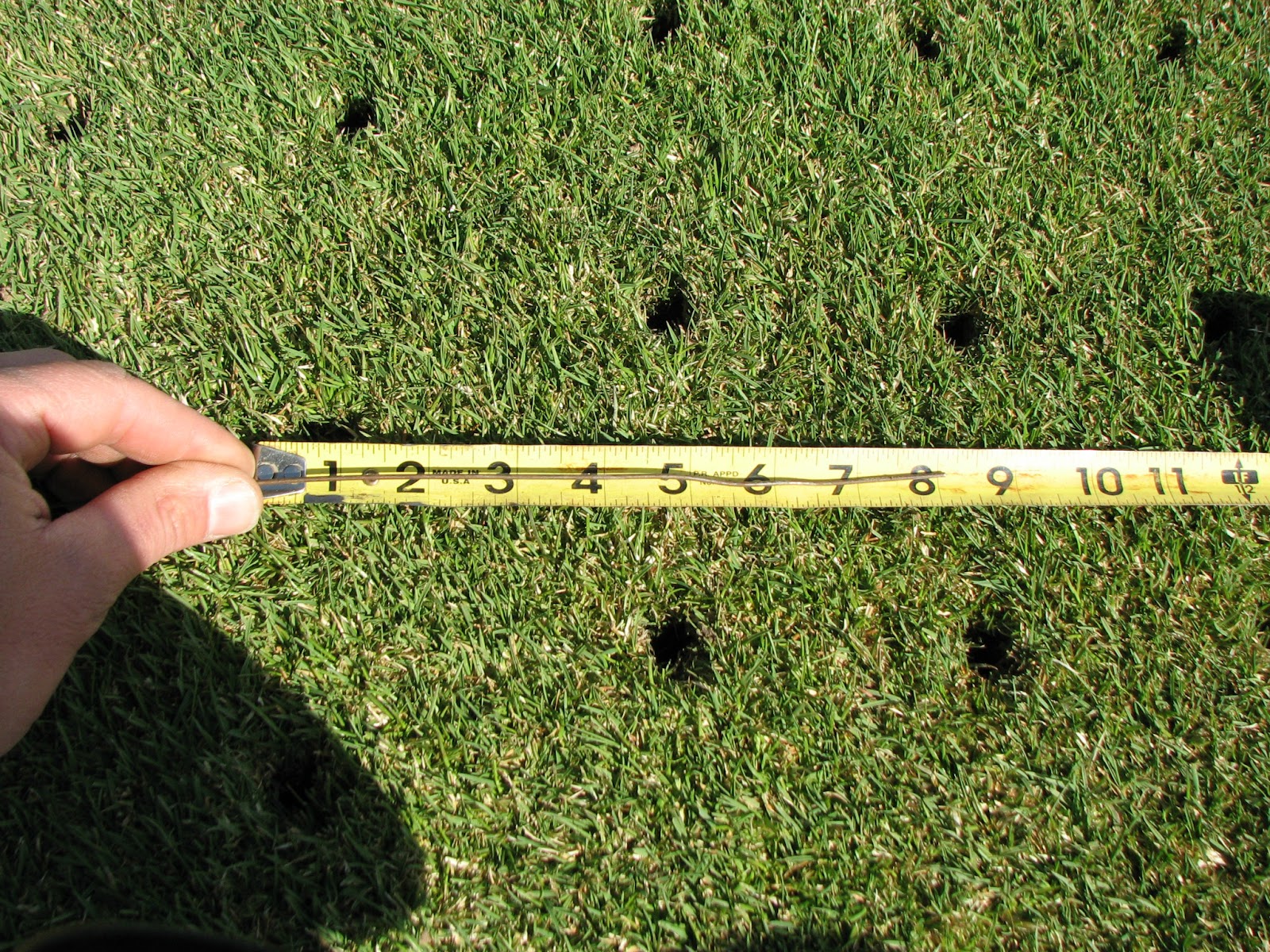
As I mentioned before one of the benefits of these machines is the depth to which they can go.  On average the tines were penetrating about 8 inches deep.


The holes on the surface will quickly grow over and become unnoticeable. The holes in the soil however, will remain open for quite some time, creating healthier turf and better playing conditions.  Here is the 2nd fairway the day after it was aerified.


While the fairways were being aerified we also aerified the front nine tees and the range tees.  Next Monday we will be aerifing the remaining tees.


We also have been using this time to complete some cart path work.  The final touches have been put on #7 cart path and it is now open for use.  I have received many positive comments on this addition as it is an easier walk onto the tees. 


You will also notice that we added a cart path extension on #1.  The area where you leave #1 fairway to transition onto the cart path had become rutted from cart traffic.  We added this stone path to help get carts through this wet area.


Also work has resumed on the front entrance of the clubhouse.  The masons are now laying the concrete pavers and should be done in a few days.